Every charger, one dashboard
ems-charge's OCPP 2.0.1 platform manages every charger across your sites from one dashboard: remote OTA firmware, dynamic load balancing, billing and tariffs, and V2G / ISO 15118 readiness — for charge point operators, fleet depots and residential portfolios.
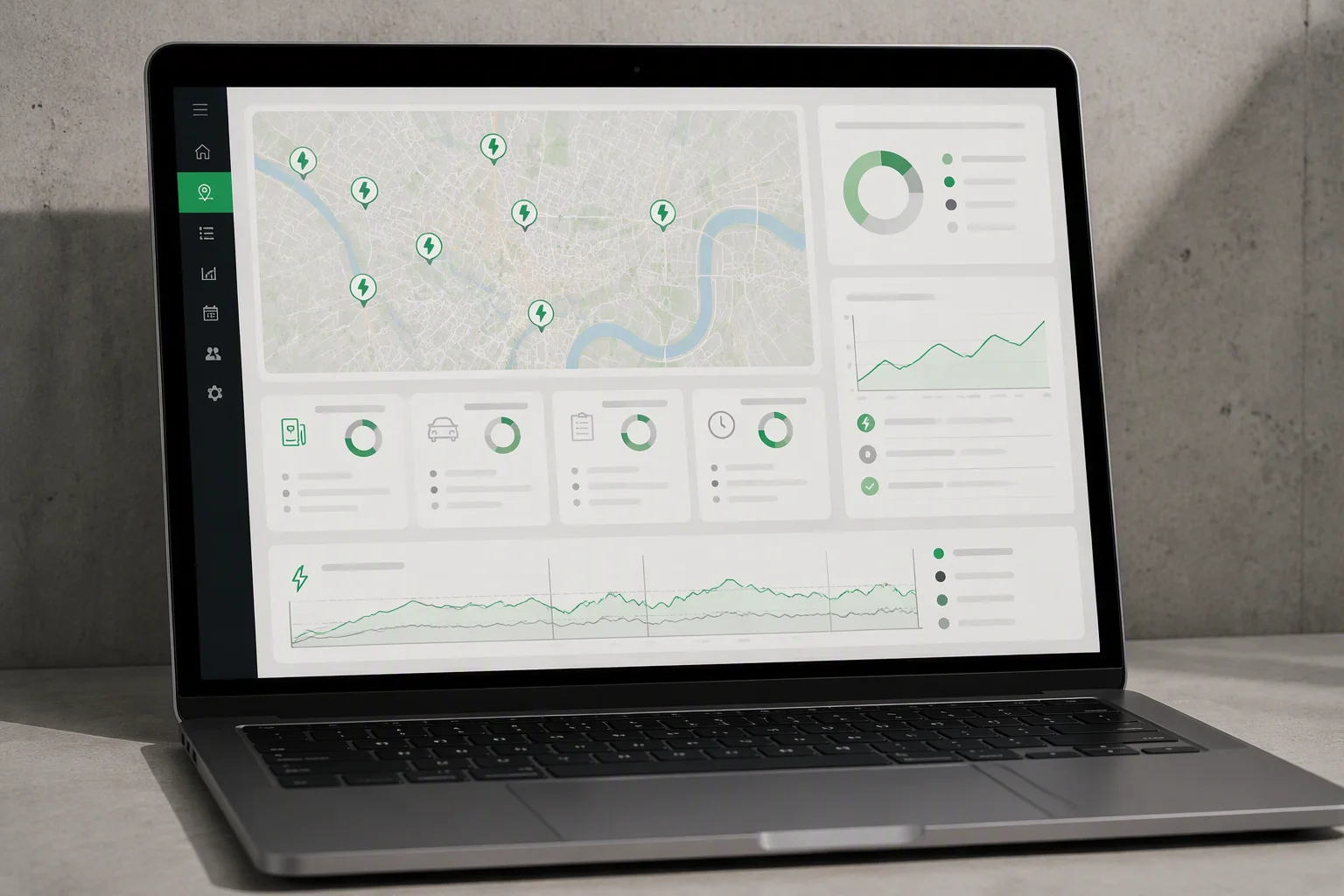
Run the whole network, not one charger.
OCPP is the open protocol chargers use to talk to a management system — and the platform is where sessions, payments, firmware and load all meet. Ours speaks OCPP 2.0.1 natively and stays compatible with OCPP 1.6J, so you can onboard chargers from multiple brands instead of being locked into one.
- Remote OTA firmware — push updates across sites without a site visit.
- Dynamic load balancing — cap demand charges that are 30–70% of a commercial bill.
- Billing and tariffs — per-session, per-user and per-port settlement.
What you control from the dashboard.
Remote OTA & firmware
Schedule signed firmware and configuration updates across a whole network, with rollback if a release fails.
Dynamic load balancing
Share a fixed grid connection across chargers so EV demand never trips the breaker or inflates demand charges.
Smart charging profiles
Set per-charger schedules and power limits to follow time-of-use tariffs and off-peak windows.
Billing & tariffs
Metered settlement with cost and tariff data attached to every transaction — ready for CPO and condo billing.
ISO 15118 Plug&Charge
Native support for certificate-based Plug&Charge, so the car authenticates and pays without an app or card.
Security & access
TLS 1.2+ security profiles, certificate management and role-based access for operators, owners and drivers.
Why the protocol version matters.
OCPP 2.0.1 replaced 1.6's flat string keys with a structured device model, added mandatory-grade security and made smart charging and ISO 15118 first-class. Buyers should ask which version a charger ships with — it decides what the network can do later.
| Capability | OCPP 1.6J | OCPP 2.0.1 |
|---|---|---|
| Spec era | 2015, JSON-only | 2020, current release |
| Data model | Flat string keys | Structured device model (components & variables) |
| Security | No mandatory TLS | TLS 1.2+ security profiles, certificate management |
| Smart charging | Basic charging profiles | Smart charging with limits, tariff and cost data |
| ISO 15118 | Vendor extensions only | Native 15118-2 Plug&Charge and 15118-20 V2G |
| Transactions | Basic start / stop | Reservations, signed meter values, cost in transaction |
| Monitoring | Log and heartbeat only | GetReport, monitoring and extended diagnostics |
| Firmware update | Basic status notification | Signed packages with a full update state machine |
One platform, three very different networks.
Charge point operators
Run mixed-brand sites under one OCPP 2.0.1 backend — the interoperability prerequisite for a resellable, multi-vendor network.
Fleet depots
73% of fleet operators rank energy cost first. Load balancing against demand charges, off-peak scheduling and V2G revenue of $3,359 per vehicle per year change that arithmetic.
Residential & condos
Per-unit OCPP billing and load sharing solve the two things that hold condos back — renters struggle twice as much to charge, and capacity is shared.
Ready for the dates the grid just set.
ISO 15118 is the car-to-charger standard behind Plug&Charge and bidirectional V2G. AFIR has turned it into a deadline, not an option — and the platform is built for both milestones.
Plug&Charge
Authenticates and pays from the car's certificate — no app, no RFID card, no driver steps.
V2G readiness
Vehicles sit parked 96% of the time; bidirectional chargers earn $3,359 per car per year selling energy back.
- 2026-01-08
ISO 15118-2 becomes mandatory for public AC charging points under AFIR.
- 2027-01-01
ISO 15118-20 — including V2G — becomes mandatory across the EU.
Built on open standards, not a walled garden.
Protocols
- OCPP 2.0.1 (WebSocket, JSON) with OCPP 1.6J compatibility
- ISO 15118-2 Plug&Charge and ISO 15118-20 V2G
- REST API for CPO backends and third-party billing
Platform
- TLS 1.2+ security profiles with certificate management
- Multi-tenant SaaS with role-based access control
- CAN / OCPP gateway for charger-level telemetry
See the platform on your chargers.
Tell us your network size, charger mix and billing needs — we schedule a walkthrough of the dashboard and share OCPP onboarding details within 48 hours.
Send Inquiry