
Install it right the first time
Site planning, cable sizing, protection and DFM rules for EV charger installation — grounded in IEC 61851-1 and OCPP, with the exact numbers your electrician needs.
What to send for a fast review.
A complete package lets our engineers confirm the design in one pass instead of three email rounds.
- 3D CAD — STEP (.stp) plus 2D PDF drawings with tolerances.
- BOM — part numbers and the approved supplier list (AVL).
- Datasheet — electrical, mechanical and environmental parameters.
- Firmware spec — OCPP version, connector profile and load-balancing behaviour.
- Compliance matrix — target standards mapped to each market.
Six rules that keep a charger in production.
Sealed enclosure
Maintain IP54/IP65 gaskets; no unfilled openings that invite moisture.
Cable bend radius
Keep at least 300 mm bend radius on liquid-cooled cables.
Thermal derating
Preserve airflow and derate above 45°C ambient for continuous duty.
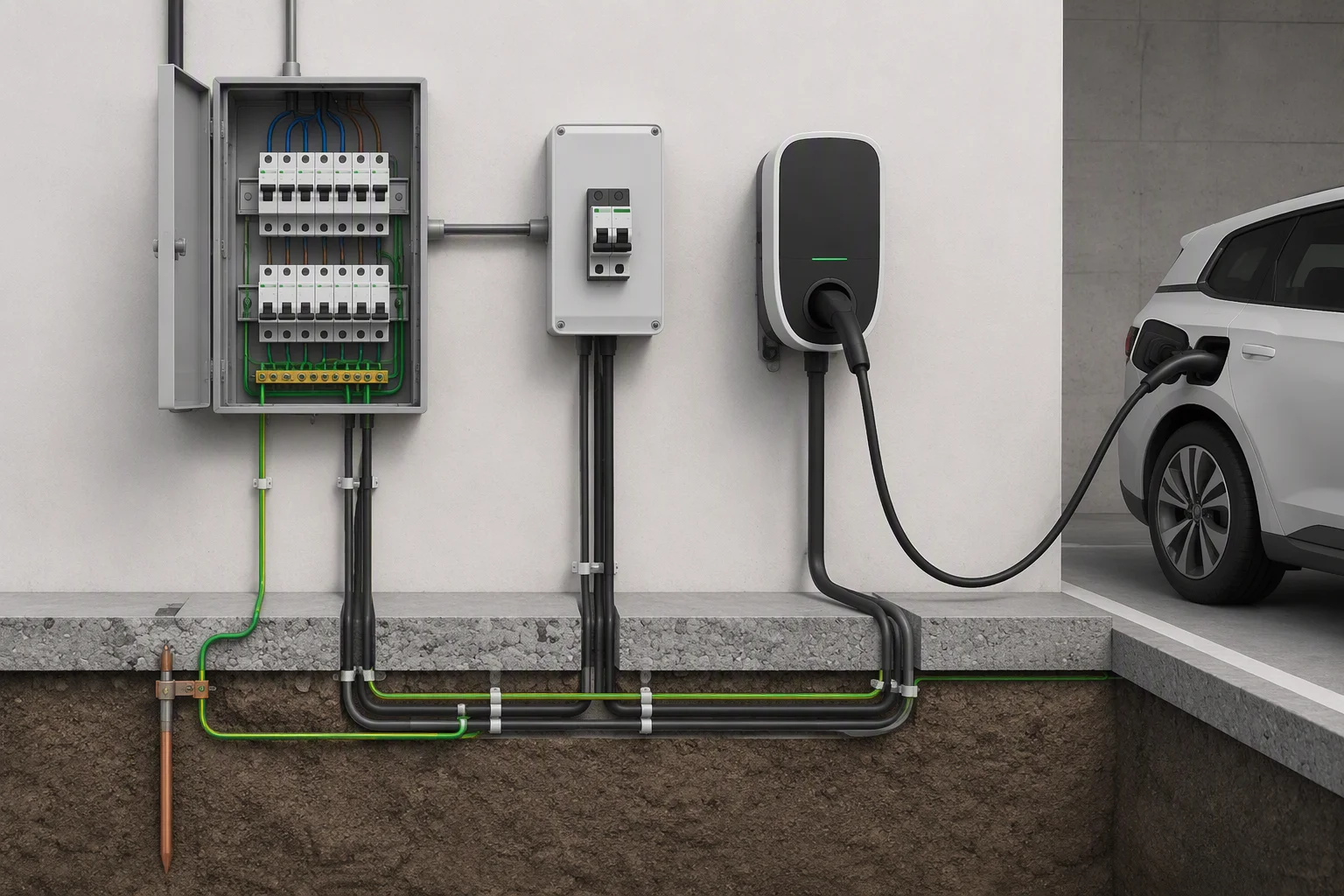
Earthing
PE continuity under 0.1 Ω to a dedicated ground bar.
Clearance & creepage
Meet IEC 61851-1 spacing for the charger's voltage class.
Surge protection
SPD rated 6 kV line-to-line and 12 kV line-to-earth.
Cable, breaker and earthing by charger size.
Copper cross-sections assume a typical run under 30 m; longer feeders need a voltage-drop recalculation to stay under 5%.
| Installation | Power | Cable (copper) | Breaker | Earthing |
|---|---|---|---|---|
| AC wallbox (1-phase) | 7.4 kW | 3×6 mm² | 40 A RCBO | 6 mm² PE |
| AC wallbox (3-phase) | 11 kW | 5×6 mm² | 20 A 3P | 6 mm² PE |
| AC wallbox (3-phase) | 22 kW | 5×10 mm² | 32 A 3P | 10 mm² PE |
| AC commercial (dual) | 2×22 kW | 5×16 mm² | 63 A 3P | 16 mm² PE |
| DC compact | 30–60 kW | 4×35 mm² + PE | 125 A MCCB | 16 mm² PE |
| DC fast | 120–180 kW | 2×95 mm² per phase | 400 A MCCB | 50 mm² PE |
| DC ultra | 240–360 kW | 4×150 mm² | 630 A MCCB | 70 mm² PE |
| RCD (all DC) | — | — | 30 mA Type B | — |
| Surge protection | — | — | 6 kV / 12 kV SPD | — |
| Load balancing | Multi-unit | — | Per-group controller | — |
What site audits keep finding.
- Undersized cable — voltage drop past 5% heats the feeder and trips protection.
- Type A RCD instead of Type B — the residual DC current a charger can leak is not detected.
- Ignoring demand charges — 30–70% of a commercial bill is demand; a 150 kW DC unit can spike it. Add load management.
- Missing 6 mA DC leakage protection — required by IEC 61851-1, not optional.
- Wrong connector for the market — CCS1 and CCS2 are not interchangeable across regions.
- No surge protection — an outdoor feeder without an SPD invites lightning damage.
- Shared feeder without load balancing — two chargers on one circuit trip the breaker at peak.
Send us the site plan, get a load calculation back.
Share your drawings and power level — our engineers return cable, breaker and protection recommendations with the quote within 48 hours.
Send Inquiry