
The export certification map
A charger that is legal in the EU can be unsellable in North America. Certification is the gate you pass to enter a market — and the place exporters lose the most time and money.
Reading time 7 min · Updated August 2026 · ems-charge engineering
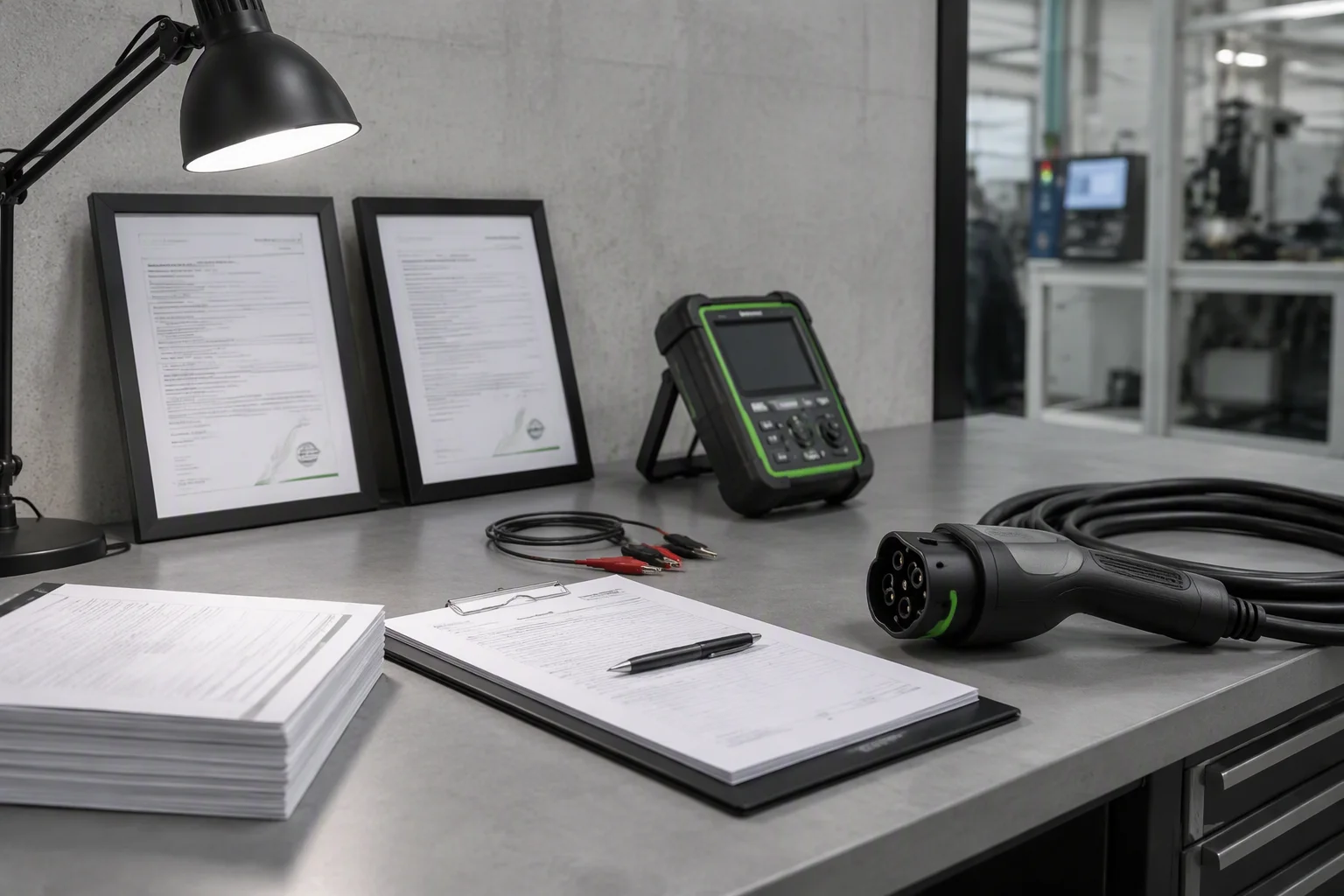
Certification is not a marketing badge; it is the gate you pass to legally sell into a market. Get it wrong and the cost is not a small delay — it is a container held at customs, a UL listing that takes another twelve weeks, and a launch window you never get back. This guide maps the regional marks, the real costs and timelines, and the five mistakes that cost exporters the most. It is written for buyers and distributors who need to spec a charger for a specific country, not for compliance engineers doing the paperwork.
Regional mapOne charger, many marks
The cleanest way to think about certification is region by region, because a mark from one region rarely transfers to another.
- European Union — CE. Mandatory market entry, covering the Low Voltage Directive, EMC and the Radio Equipment Directive where wireless is present. RoHS and REACH sit alongside it. IEC 61851-1 is the underlying global safety standard most EU assessments reference.
- North America — UL, ETL or CSA. UL 2594 covers AC chargers, UL 2202 covers DC fast chargers, and UL 2231 covers personnel-protection (ground-fault) systems. FCC is mandatory for wireless. ETL and CSA are recognised, lower-cost alternatives to the UL mark with the same acceptance.
- China — GB/T. GB/T 18487 and GB/T 20234 govern domestic chargers and connectors; mandatory for in-country sale.
- Rest of world. Australia/New Zealand add AS/NZS 4777.2 for grid-interactive units; Malaysia uses SIRIM, Singapore TR25, and Japan CHAdeMO certification for its connector standard.
- Software, everywhere. OCPP 1.6/2.0.1 for backend interoperability, and ISO 15118 for Plug&Charge and V2G — which is becoming a legal requirement, not an option, in the EU.
| Region | Required mark | Key standards |
|---|---|---|
| European Union | CE | LVD, EMC, RED, RoHS, REACH |
| North America | UL / ETL / CSA + FCC | UL 2594, UL 2202, UL 2231 |
| China | GB/T | GB/T 18487, GB/T 20234 |
| Australia / NZ | RCM | AS/NZS 4777.2 |
| Malaysia / Singapore | SIRIM / TR25 | Local variants of IEC |
| Global (software) | OCPP, ISO 15118 | OCPP 2.0.1, ISO 15118-20 |
Budget for the mark, not just the unit
Certification is a line item with real ranges, and the DC numbers surprise first-time exporters. Plan for these figures before you price a market:
| Certification | Typical cost | Typical cycle |
|---|---|---|
| New CE (LVD + EMC + RED) | $8,000–25,000 | 8–16 weeks |
| New ETL / UL (AC) | $15,000–35,000 | 8–16 weeks |
| New ETL / UL (DC) | $25,000–60,000 | 12–20 weeks |
| OCPP 2.0.1 conformance | $2,000–5,000 | 2–4 weeks |
| ENERGY STAR (standby) | $3,000–8,000 | 4–8 weeks |
The ranges exist because DC testing is harder than AC: higher voltages, more fault conditions, and longer thermal runs. A 360 kW liquid-cooled unit costs more to certify than a 22 kW wallbox, and a re-test after a design change can cost nearly as much as the first pass. Build the certification budget into the unit economics from day one, not as a post-purchase surprise.
Common pitfallsFive mistakes that delay exports
- Assuming CE covers everywhere. CE is an EU mark. It does not clear North America (UL/ETL), China (GB/T) or Australia. A charger sold in the US on a CE declaration alone is non-compliant.
- Treating CE as "tested." CE is largely a manufacturer's self-declaration for the LVD, with Notified Body involvement only for certain directives like RED. "CE marked" and "independently tested" are not the same thing — ask who signed the declaration of conformity.
- Testing a unit that is not the production unit. The mark applies to the exact configuration tested. A connector swap, a new power module or a firmware change can invalidate the listing; changes mid-cycle restart the clock.
- Ignoring the ISO 15118 deadline. Under AFIR, public AC chargers must support ISO 15118-2 from 2026-01-08, and ISO 15118-20 (including V2G) becomes mandatory from 2027-01-01. A charger without it cannot legally serve EU public networks after those dates — regardless of its CE mark.
- Skipping standby and system marks. North America's ENERGY STAR sets a standby budget of a 4 W base plus allowances (1 W Wi-Fi, 2 W cellular, 1.5 W RFID, 5 W credit-card reader); IATF 16949 alignment matters if you are selling into an automotive OEM supply chain rather than directly to operators.
| Public AC — ISO 15118-2 | 2026-01-08 |
|---|---|
| Public — ISO 15118-20 (V2G) | 2027-01-01 |
| ENERGY STAR standby base | 4 W + allowances |
Certify for the market, not the map on your wall
Pick the region first, confirm the mark second, and let the certification budget shape the unit price third. A charger spec'd with the right marks from the start — CE for Europe, UL/ETL for North America, GB/T for China, ISO 15118 for the EU's 2027 requirement — ships without customs surprises and sells without legal exposure. ems-charge runs CE, UL 2594/2202/2231, IEC 61851-1 and ISO 15118 alignment across its AC and DC lines, and we handle the certification scope for your target market as part of the quote. Tell us where you are selling, and we'll map the exact marks, cost and lead time before you commit.
Need a charger certified for your market?
Tell us your target region — we'll confirm the CE, UL/ETL or GB/T scope, cost and timeline, and reply with specs and pricing in 48 hours.
Send Inquiry