
Choosing DC charger power, by the numbers
The rating on the label is not the number that matters. Dwell time, utilisation and efficiency decide whether a charger pays for itself — the kW figure only sets the ceiling.
Reading time 7 min · Updated August 2026 · ems-charge engineering
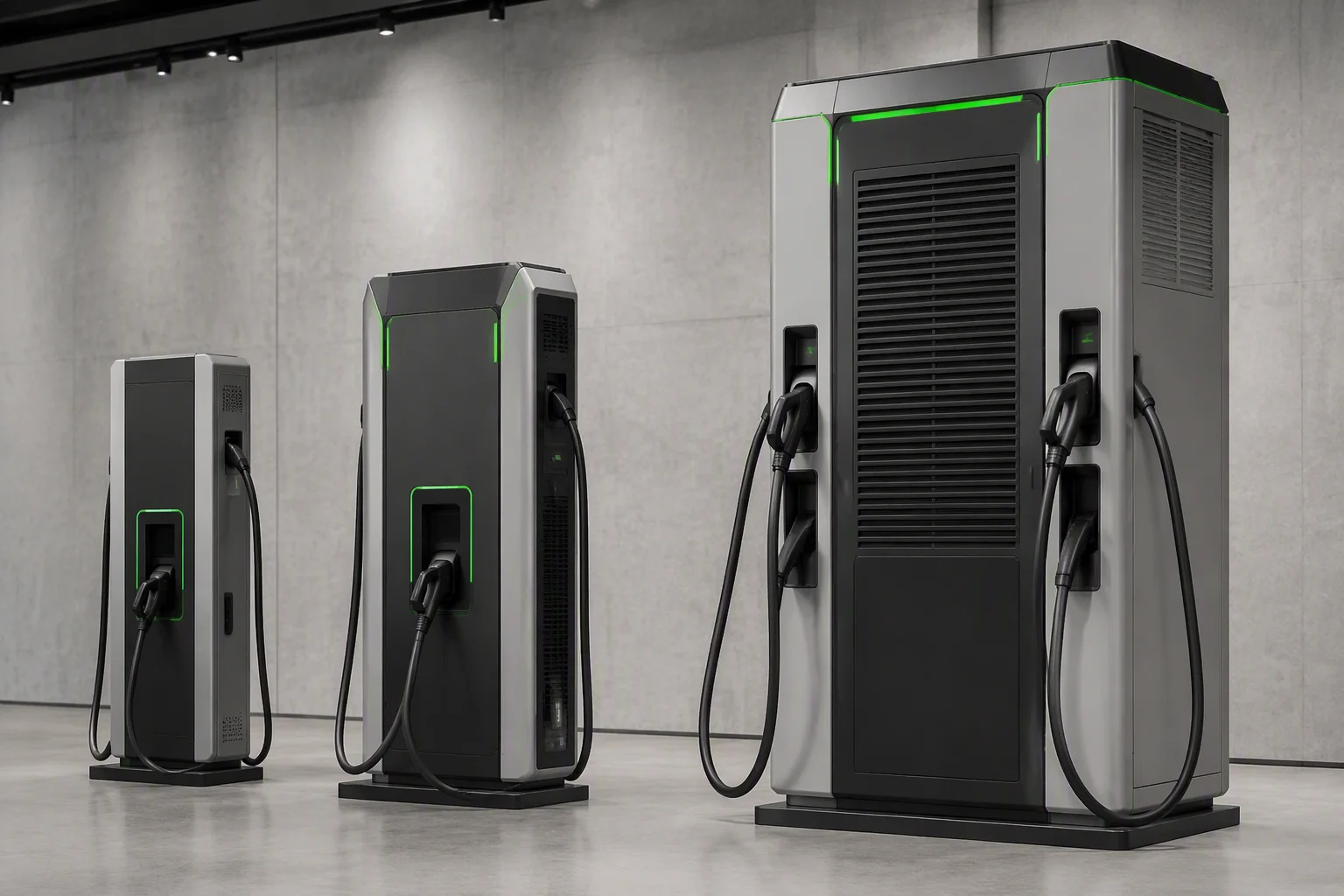
A DC fast charger's power rating is the number printed on the cabinet, but the number that determines your return is the one on the electricity bill and the utilisation report. A 360 kW charger averaging 40 kW of delivered power is a financing mistake; a 60 kW unit on a highway rest stop is a queue that sends drivers to the next exit. Choosing power is a site-economics exercise, not a spec-sheet contest. This guide walks through the three power bands, a dwell-time selection matrix, and the efficiency arithmetic that turns a two-point gain into roughly 4,380 kWh of free energy per charger per year.
Power tiersThree bands, three jobs
30–60 kW, all-in-one. The workhorse for retail, workplace and destination charging. Vehicles stay 30 minutes to two hours, so a 50 kW average is plenty. Utilisation is the constraint here, not speed: an AC port typically turns 1–3 sessions a day, while a DC port turns 3–10. A compact DC unit at this band captures the 3–10 range without the grid-upgrade cost of a bigger cabinet.
120–180 kW, dual gun. The fleet and highway band. Two connectors share power intelligently so a depot can charge two electric trucks at once, or one car at the full rate. The commercial pull is strong: the electric-truck market is forecast to grow from roughly $21.3 billion in 2026 toward $170.9 billion by 2034, a 29.7% CAGR, and every one of those trucks needs predictable, high-power overnight charging at a depot rather than a public stop.
240–360 kW, liquid cooled. The corridor band. A 500 A liquid-cooled cable sustains the full rate without thermal derating, which is exactly what EU AFIR rules are pushing: from the end of 2025, TEN-T corridor sites must offer at least 400 kW every 60 km. When a driver stops for 15–20 minutes, the charger has to be able to pour in the maximum the battery will accept for the entire stop — not the first five minutes.
| Band | Typical site | Whole-unit efficiency | Best fit |
|---|---|---|---|
| 30–60 kW | Retail, workplace | ≥93% | Dwell 30 min–2 h |
| 120–180 kW | Fleet, fuel station | ≥94% | Dual-gun shared, 2 cars |
| 240–360 kW | Highway corridor | ≥94% (SiC) | 15–20 min stops, AFIR |
Let dwell time pick the power
The single most reliable input is dwell time — how long a vehicle actually stays, not how long you hope it stays. Match the power to the visit, and both utilisation and driver satisfaction improve together.
- 5–15 minute stops (highway, taxi queues) → 240–360 kW liquid-cooled. Speed is the product.
- 30–60 minute stops (fuel stations, fast-casual retail) → 60–120 kW. Enough for a meaningful top-up without overbuilding.
- 1–4 hour stays (supermarkets, gyms, offices) → 7–22 kW AC or a shared 30–60 kW DC bank.
- Overnight depots (8+ hours) → 60–120 kW shared across several trucks with load balancing, not one big charger per bay.
The common mistake is buying for peak battery acceptance instead of average session demand. A 120 kW dual-gun charger serving a 40-minute retail dwell will rarely leave the 60 kW band — so the extra capacity is capital sitting idle. Conversely, a 60 kW unit on a 20-minute corridor stop will never fill a modern battery, and drivers will vote with their wheels.
The economicsEfficiency is a revenue line, not a footnote
Two efficiency points sound academic until you price them. Lifting a 120 kW charger's whole-unit efficiency from 94% to 96% saves about 4,380 kWh per year per unit — energy that was previously leaving the cabinet as heat. Across a fleet of ten chargers that is roughly 43,800 kWh a year back on the balance sheet, before you count the reduced cooling load on the site.
That is why the internals matter as much as the label. A quality DC unit holds a power factor of 0.98–0.99 and keeps total harmonic distortion under 5% — both of which matter because demand charges can be 30–70% of a commercial electricity bill, and a single DC charger can pull 50–150 kW by itself. Poor power factor inflates the apparent-power portion of a commercial tariff, and harmonic currents can attract utility penalties on top. Efficiency and power quality are not separate from the purchase decision; they are the purchase decision's second half.
Cooling is the quiet cost driver behind all of this. On a 120 kW-and-up charger, the cooling system typically represents 15–25% of the bill of materials. SiC-based power modules run cooler and more efficiently, which is why the ultra-fast band defaults to liquid-cooled SiC — the higher per-unit price buys back both the efficiency points and a longer thermal life.
| 120 kW @ 94% → 96% | ~4,380 kWh saved / year |
|---|---|
| Power factor (DC) | ≥0.98–0.99 |
| THDi (DC) | ≤5% |
| Cooling share of BOM (120 kW+) | 15–25% |
Buy the power the visit needs
Pick the band from dwell time, then let efficiency decide which unit inside that band to buy. The label tells you the ceiling; the efficiency, power factor and utilisation tell you the return. If you are unsure where a site lands, start from the visit: how long do vehicles actually stay, and how many of them arrive in a day? From there the power tier almost selects itself. ems-charge ships 30–60 kW compact, 120–180 kW dual-gun and 240–360 kW liquid-cooled DC chargers across one platform — tell us your dwell time and daily sessions, and we'll size the right band and the right module count.
Not sure which band your site needs?
Send us your dwell time, daily sessions and grid supply — we'll size the right DC charger and reply with specs, pricing and lead time in 48 hours.
Send Inquiry